
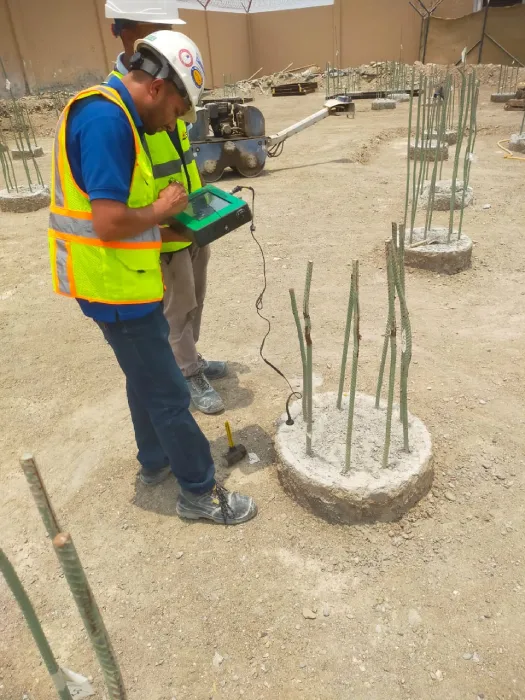
Piles are essential foundation components designed to carry structural loads and transfer them safely to deeper, stronger soil strata. Because they play such a critical role in structural stability, it is important to verify their performance before and during construction. This is achieved through pile testing, which evaluates both the load capacity and structural integrity of installed piles. In this article, we examine the main pile testing methods, equipment used, and practical procedures applied on construction sites.
Introduction to pile testing
Pile testing is a critical part of deep foundation construction. It verifies that piles can safely carry the structural loads they were designed for. Without proper pile testing, there is no reliable way to confirm load capacity, settlement behavior, or overall performance of the foundation system.
What Is Pile Testing?
Pile testing is the process of evaluating the load-bearing capacity and integrity of piles used in deep foundation construction. It also confirms that the installed piles meet the design requirements that was specified by structural and geotechnical engineers.
there for Pile testing is typically conducted before or during construction to:
- Satisfy consultant and authority requirements, (sometimes they will ask for it)
- Verify design assumptions
- Confirm safe load capacity
- Measure settlement behavior
- Detect structural defects
Importance of Pile Testing
Pile testing reduces risk. Foundations transfer structural loads to deeper, stronger soil layers. If a pile fails, the entire structure may be compromised.
Key benefits of pile testing include:
- Ensuring structural safety
- Preventing overdesign (which increases cost)
- Avoiding under design (which risks failure)
- Verifying installation quality
- Meeting project specifications and codes
In major construction projects, pile testing isn’t an option, it’s mandatory.
Types of Pile Testing
There are two main categories of pile testing: load testing and integrity testing.
1. Static Load Test (SLT)
A Static Load Test (SLT) is a pile testing method used to measure the actual load-bearing capacity of a pile.
A hydraulic jack applies load gradually while settlement is carefully recorded.
It is the most reliable way to verify pile performance and confirm design safety.
simply, it checks if the pile can safely carry the weight it was designed for.
How It Works
A controlled load is applied to the pile using hydraulic jacks. The load is increased gradually in stages while settlement is measured using precise instruments.
What It Measures
- Ultimate load capacity
- Settlement under working load
- Load vs. displacement behavior
Advantages
- High accuracy
- Direct measurement of performance
- Accepted by all consultants and authorities
Limitations
- Time-consuming
- Requires heavy reaction systems
- Higher cost compared to dynamic testing
Static load tests are often required for preliminary test piles before full production begins.
2. Dynamic Load Test (High Strain Test)
Dynamic Load Testing is a pile testing method used to estimate the load capacity of a pile by applying a sudden impact force, usually with a hammer, and measuring how the pile responds. Sensors record stress waves traveling through the pile, and the data is analyzed to calculate its capacity.
In simple terms, it checks the pile’s strength by hitting it and measuring how it reacts.
How It Works
A hammer impact is applied to the pile head, and sensors measure stress waves traveling through the pile. The data is analyzed to estimate load capacity.
Advantages
- Faster than static load testing
- Lower cost
- Suitable for testing multiple piles
Limitations
- Results are indirect and require signal matching analysis
- Accuracy depends on soil conditions and data interpretation
Dynamic load testing is commonly used for driven piles but can also be applied to bored piles in certain conditions.
3. Pile Integrity Test (Low Strain Test)
Pile Integrity Test (PIT) is a non-destructive method used to check the structural condition of a pile. A small hammer taps the pile head, and a sensor measures the stress waves that travel down and reflect back. The results help identify cracks, voids, necking, or changes in pile length.
in simple words: it’s a quick check to see if the pile has internal defects.
How It Works
A small hammer taps the pile head, generating stress waves. Reflected signals indicate possible defects such as cracks, necking, or voids.
What It Detects
- Cracks
- Changes in cross-section
- Poor concrete quality
- Major structural discontinuities
Integrity testing does not measure load capacity but confirms construction quality.
4. Crosshole Sonic Logging (CSL)
Crosshole Sonic Logging (CSL) is a non destructive test used mainly for bored cast-in-place piles. Tubes are installed inside the reinforcement cage before concreting. After the concrete has cured, ultrasonic signals are sent between the tubes to detect internal flaws or voids.
It checks the quality and continuity of the concrete inside the pile along its entire length.
Simply put sending sound waves through the pile to make sure the concrete is solid and continuous.
CSL is used mainly for bored cast-in-situ piles.
How It Works
Access tubes are installed inside the reinforcement cage before concreting. After curing, ultrasonic signals are sent between tubes to detect internal flaws.
Advantages
- Detects internal defects
- Suitable for large-diameter bored piles
Lateral Load Testing
Lateral Load Testing measures how a pile reacts to horizontal forces rather than vertical weight. Hydraulic jacks apply sideways pressure to the pile while sensors record deflection and movement.
This test is important for structures exposed to wind, earthquakes, or soil pressure, such as bridges, high-rise buildings, and marine foundations.
Simply put: it checks how strong the pile is against sideways forces.
Pile Testing Procedures
remember Proper planning is essential for accurate results.
Step 1: Select Test Piles
Test piles are chosen based on project requirements. Some projects require preliminary test piles before production piling begins.
Step 2: Prepare the Pile Head
The pile head must be trimmed and properly prepared to ensure uniform load transfer and that’s very important.
Step 3: Install Reaction System
For static load tests, a reaction system (kentledge or anchor piles) is installed to resist applied loads.
Step 4: Instrumentation and Monitoring
Dial gauges, settlement plates, or electronic sensors are installed to measure displacement accurately.
Step 5: Load Application and Recording
Loads are applied in increments, and settlement readings are recorded at each stage.
Step 6: Data Analysis and Reporting
Engineers analyze the load settlement curve to determine whether the pile meets design capacity.
Acceptance Criteria
So, when it comes to pile acceptance depends on:
- Maximum allowable settlement
- Achieved ultimate capacity
- Structural integrity
- Compliance with project specifications
Consultants review the test results before approving production piling.
Common Issues in Pile Testing
When it comes to pile testing, things don’t always go perfectly on the first try. Sometimes the pile head isn’t prepared properly, or the sensors give faulty readings. Pumps or jacks can misbehave, or the reaction system might shift slightly. Even small mistakes like this can throw off the results. That’s why careful supervision, planning, and double-checking equipment are just as important as the test itself, because even a strong pile can look weak if the process isn’t handled right.
Even with proper planning, challenges may arise:
- Improper pile head preparation
- Equipment malfunction
- Misalignment of hydraulic jacks
- Inaccurate settlement readings
- Poor reaction system stability
Strict supervision and quality control reduce these risks.
Best Practices for Reliable Pile Testing
Pile testing works best when done carefully and thoughtfully.
Attention to detail and proper supervision make the results reliable.
Following best practices ensures the piles truly reflect the foundation’s strength and stability.
- Conduct preliminary testing before mass production
- Use calibrated equipment
- Ensure proper pile curing before testing
- Follow approved method statements
- Maintain detailed documentation
Clear coordination between contractor, consultant, and testing agency ensures accurate and accepted results.
Pile Testing for Bored Piles
when it comes to Bored piles it requires careful testing because defects may not be visible. Integrity testing and CSL are commonly specified to verify concrete quality and continuity.
Proper cleaning of the borehole, correct reinforcement placement, and controlled concreting directly influence test outcomes.
Quality Assurance in Pile Testing
Pile testing is part of the overall foundation quality assurance plan. It confirms that installed piles match the design intent and perform safely under load.
Professional contractors integrate pile testing with inspection procedures, material checks, and engineering review to maintain high construction standards.
Conclusion about pile testing
well Pile testing is essential for verifying deep foundation performance. Through static load tests, dynamic testing, integrity checks, and advanced methods like CSL, engineers can confirm load capacity and structural soundness.
When properly planned and executed, pile testing protects structural safety, controls risk, and ensures compliance with project specifications.
For projects requiring reliable deep foundation solutions and professional pile testing coordination, KON General Contracting provides experienced execution aligned with engineering standards and consultant requirements. Contact us to learn more about our foundation construction and quality assurance practices.